The Chart
A full Tetriamantic reading is arranged on a tetrahedron: a three-dimensional shape with four points, six edges, four triangular faces, and one complete whole.
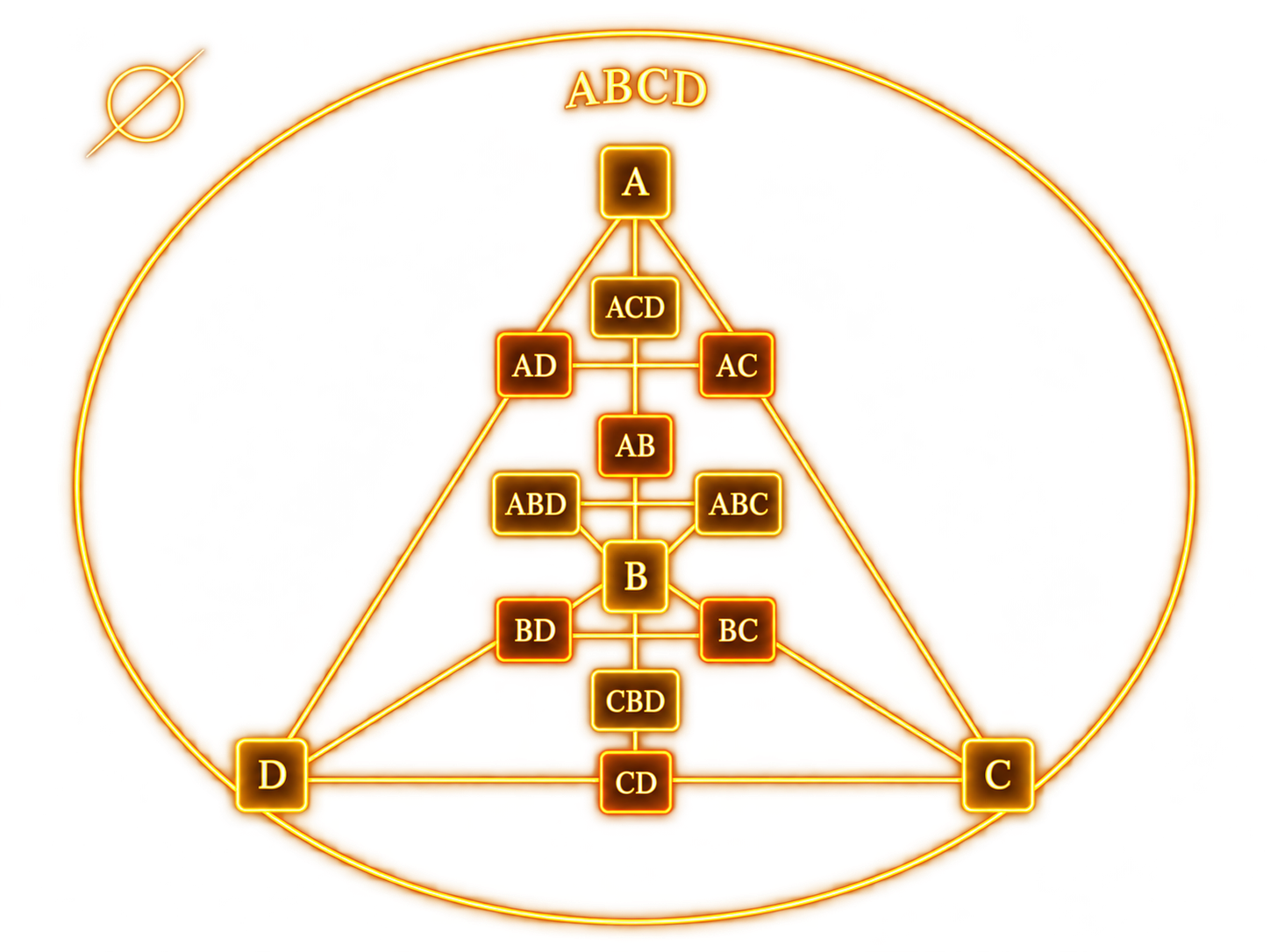
The chart contains fifteen positions:
- 4 Sources: A, B, C, D
- 6 Bonds: AB, AC, AD, BC, BD, CD
- 4 Fields: ABC, ABD, ACD, BCD
- 1 Whole: ABCD
To rephrase:
- The 4 Sources are the vertices/angles of the tetrahedron.
- The 6 Bonds are the edges connecting them.
- The 4 Fields are the triangular faces of the tetrahedron.
- The 1 Whole is the entire tetrahedron.
You do not need to memorize these before performing readings; the letters themselves tell you what a position is describing.
For example:
- A describes Will.
- B describes Encounter.
- AB describes what happens when Will meets Encounter.
- ABC describes the larger situation produced by Will, Encounter, and Form together.
- ABCD describes the entire situation as one whole.
A useful rule to remember is:
The position tells you what is being described.
The figure tells you how it is behaving.
If a figure suggesting concealment appears at AB, the reading is not simply “concealment.”
It is concealment in the relationship between Will and Encounter.
If a figure suggesting expansion appears at CD, it describes expansion in the relationship between Form and Actuality: something possible becoming increasingly real.
Once you understand the positions, the chart becomes much easier to read.
The Four Sources
The four Sources are the figures from which the rest of the chart is generated.
They are the four fundamental ways a situation can be examined.
A: Will
Will · Being · Becoming
A describes what seeks to happen.
It concerns:
- intention
- desire
- aspiration
- direction
- choice
- initiative
- purpose
- what something seeks to become
A does not necessarily mean conscious intention.
Will may be obvious, conflicted, hidden, developing, or almost entirely latent.
Ask:
What is trying to happen?
or:
What is being willed?
A corresponds to Fire and, in the Four Worlds, Atziluth.
B: Encounter
Encounter · Experience · Relation
B describes what it is like to meet the situation.
It concerns:
- lived experience,
- feeling,
- perception,
- relationship,
- response,
- what is encountered,
- how circumstances are experienced from within.
The “other” encountered at B does not have to be another person.
It may be an institution, opportunity, obstacle, memory, environment, body, circumstance, or simply reality pushing back against Will.
Ask:
What is being encountered?
and:
How is this being experienced?
B corresponds to Water and Briah.
B also occupies the place corresponding to Tiphareth in the Tree-of-Life overlay, making it the experiential center of the chart: the place where the chart becomes something lived.
C: Form
Form · Possibility · Intelligibility
C describes the structures through which something can exist, develop, or be understood.
It concerns:
- possibility,
- pattern,
- interpretation,
- language,
- strategy,
- classification,
- planning,
- models,
- the form something could take.
C is not simply “thinking.”
A blueprint is C.
A theory is C.
A social role is C.
A melody, ritual structure, algorithm, legal category, or plan can all belong to C.
Ask:
What form can this take?
and:
How can this be understood or organized?
C corresponds to Air and Yetzirah.
D: Actuality
Actuality · Matter · Embodiment
D describes what is actually the case.
It concerns:
- material circumstances,
- action,
- embodiment,
- resources,
- consequences,
- facts,
- limitations,
- enacted behavior,
- what has become concrete.
D is especially useful because what we want, feel, or imagine is not always what actually happens.
Ask:
What is materially happening?
or simply:
What is real here?
D corresponds to Earth and Assiah.
The Six Bonds
The Bonds are the six edges of the tetrahedron.
Each Bond joins two Sources and describes what happens between them.
If the Sources are the basic ingredients of the situation, the Bonds describe their relationships.
AB: Will and Encounter
Relation · Contact · Knowledge through experience
AB describes what happens when intention meets something outside itself.
It concerns:
- self and other,
- desire meeting response,
- attraction and aversion,
- cooperation,
- resistance,
- conflict,
- relationship,
- what becomes known through contact.
A asks:
What do I seek?
B asks:
What do I encounter?
AB asks:
What happens between what I seek and what I meet?
AB corresponds to Da’ath in the Tree-of-Life overlay.
AC: Will and Form
Conception · Ideation · Generative possibility
AC describes the relationship between intention and possible form.
It concerns:
- imagination,
- conception,
- planning,
- creativity,
- strategy,
- possible futures,
- the shape implicit within an intention.
A asks:
What seeks to become?
C asks:
What form can it take?
AC asks:
What could this Will become?
This is often the position of the idea before it becomes the finished thing.
AC corresponds to Chokmah.
AD: Will and Actuality
Efficacy · Limitation · Embodied Will
AD describes what happens when intention encounters material reality.
It concerns:
- effectiveness,
- agency,
- constraint,
- discipline,
- execution,
- resistance,
- consequences,
- what reality allows Will to become.
A asks:
What do I want?
D asks:
What is actually possible here?
AD asks:
What happens when Will has to become real?
Limitations at AD are not necessarily failures.
Limits can frustrate Will, but they can also give it enough structure to endure.
AD corresponds to Binah.
BC: Encounter and Form
Value · Meaning · Desire · Interpretation
BC describes the forms that experience gives to the world.
It concerns:
- attraction,
- preference,
- interpretation,
- aesthetic response,
- valuation,
- narrative,
- what we invest with importance,
- the meanings created from experience.
B asks:
What am I experiencing?
C asks:
What form does this take?
BC asks:
What shape does experience give the world?
This is where raw experience begins becoming meaning.
BC corresponds to Netzach.
BD: Encounter and Actuality
Consequence · Observation · Articulation
BD describes what material reality is like when it is actually experienced.
It concerns:
- lived consequences,
- observation,
- measurement,
- description,
- embodied response,
- what reality feels like once it arrives,
- how actual conditions become understandable or communicable.
D asks:
What happened?
B asks:
What was it like?
BD asks:
How is what happened being experienced and understood?
BD corresponds to Hod.
CD: Form and Actuality
Manifestation · Realization · Implementation
CD describes what happens when possibility meets material reality.
It concerns:
- manifestation,
- implementation,
- plans becoming concrete,
- ideas becoming objects,
- possibility becoming fact,
- what survives the transition from model to reality.
C asks:
What can this become?
D asks:
What actually exists?
CD asks:
What becomes real?
This makes CD one of the most immediately practical positions in the chart.
It is where possibility has to survive contact with matter.
CD corresponds to Malkuth.
The Four Fields
The four Fields are the triangular faces of the tetrahedron.
A Field contains three Sources and the three Bonds connecting them.
While a Bond describes a relationship between two things, a Field describes the larger environment produced when three things operate together.
There is another important feature:
Every Field excludes exactly one Source.
Sometimes the missing Source tells you just as much as the three Sources that are present.
ABC: Will, Encounter, and Form
Ordered possibility
ABC contains:
- Will,
- Encounter,
- Form,
but excludes Actuality.
It describes the world being imagined, experienced, organized, or planned before material reality settles the question.
It may concern:
- plans,
- visions,
- imagined futures,
- relational possibilities,
- conceptual worlds,
- what people believe could happen,
- the shape a situation is trying to take.
Ask:
What world is being created before actuality gets the final word?
Because D is absent, ABC can sometimes show a beautiful, coherent, or convincing possibility that has not yet been tested materially.
ABC corresponds to Chesed.
ABD: Will, Encounter, and Actuality
Action · Force · Consequence
ABD contains:
- Will,
- Encounter,
- Actuality,
but excludes Form.
It describes situations where intention and experience move directly into action or consequence.
It may concern:
- decisive action,
- confrontation,
- enforcement,
- immediate response,
- necessity,
- consequences,
- doing something before everything has been fully understood.
Ask:
What happens when this situation moves directly into action?
Because C is absent, ABD can sometimes describe life acting before anyone has found the proper model, explanation, strategy, or alternative.
ABD corresponds to Geburah.
ACD: Will, Form, and Actuality
Architecture · Becoming · Manifestation as a process
ACD contains:
- Will,
- Form,
- Actuality,
but excludes Encounter.
It describes the complete movement from intention, through possible form, into actuality without asking what it feels like to experience that movement.
It may concern:
- the architecture of a process,
- creation,
- systems,
- causation,
- implementation,
- how something comes into being,
- the underlying structure of becoming.
Ask:
What is the structure through which this is becoming real?
Because B is absent, ACD can describe an elegant or functional process without telling us whether it is pleasant, meaningful, or humane to live through.
ACD corresponds to Kether.
BCD: Encounter, Form, and Actuality
Foundation · Existing pattern · The world already in motion
BCD contains:
- Encounter,
- Form,
- Actuality,
but excludes Will.
It describes the conditions that already exist independently of deliberate intention.
It may concern:
- environment,
- inherited circumstances,
- memory,
- established patterns,
- existing systems,
- conditions already in motion,
- what continues whether or not anyone consciously chooses it.
Ask:
What is already here before Will intervenes?
or:
What happens if deliberate Will is removed from the situation?
Because A is absent, BCD can reveal the pattern the querent is entering rather than the pattern they are consciously creating.
BCD corresponds to Yesod.
Note: Depending on how the tetrahedron is drawn, you may see this face written as CBD on diagrams. BCD and CBD contain the same three Sources; the order of the letters does not change which Field is being described.
The Whole
The Whole is different from every other position in the chart.
The Sources describe fundamental aspects of a situation. The Bonds describe relationships between them. The Fields describe larger environments created by three Sources acting together.
The Whole contains all of them at once.
For that reason, it is not another position on the chart; it is the chart considered as a complete being: every intention, encounter, form, actuality, relationship, tension, possibility, and consequence gathered into a single condition.
Symbolically, this places the Whole in relationship with Adam Kadmon, the Primordial Human of Qabalistic thought.
Adam Kadmon is not simply a human being in the ordinary sense—the figure represents humanity, and by extension the created order, understood as an original and undivided totality before its qualities are distinguished from one another.
This makes Adam Kadmon a useful image for understanding the role of the Whole in Tetriamancy.
The Tree of Life allows us to examine the structure piece by piece: Kether, Chokmah, Binah, Tiphareth, Malkuth, etc., and the relationships among them. Adam Kadmon represents the greater unity in which those differentiated parts belong to one body.
The Tetriamantic chart works similarly.
A, B, C, and D may be examined separately. Their Bonds show how they interact. Their Fields show the larger patterns those interactions create.
But none of these exists independently of the entire tetrahedron.
The Whole is that tetrahedron understood as one thing.
In practical terms, this means the Whole answers a different kind of question than the rest of the chart.
Rather than asking:
What does Will seek?
or:
What happens between Form and Actuality?
the Whole asks:
What is the complete condition produced by everything happening here together?
The correspondence to Adam Kadmon is therefore symbolic rather than necessary to practice. You do not need to know Qabalah to interpret the Whole.
It is enough to remember:
The other positions describe parts of the situation.
The Whole describes the situation as a living totality.
ABCD: The Whole
The Whole · Judge
ABCD contains everything.
It combines:
- all four Sources,
- all six Bonds,
- all four Fields.
It therefore does not describe one particular part of the question.
It describes:
the state of the entire situation when everything in the chart is considered together.
Ask:
What is this whole situation doing?
ABCD functions similarly to the Judge in Geomancy, but there is an important distinction.
It is not merely the final figure calculated at the end of the reading.
It is the figure of the entire tetrahedron considered as one system.
Every major division of the chart ultimately recombines into ABCD.
For practical purposes, ABCD is where you look when you want the chart’s most concentrated statement of its overall condition.
Reading a Position
When reading any position, begin with its meaning.
Then examine the figure occupying it.
For example, suppose AC contains a figure whose structure suggests strong manifestation.
AC concerns Will becoming Form.
The reading therefore asks how manifestation is operating within conception, planning, or generative possibility.
Perhaps an idea has become unusually definite.
Perhaps a plan has moved beyond speculation.
Perhaps the querent’s desire has found a clear form.
Now imagine the same figure appearing at BD.
The figure has not changed.
The position has.
BD concerns Encounter meeting Actuality, so the same strong manifestation may describe concrete consequences becoming impossible to ignore or an experience becoming clear enough to name and report.
This is the basic grammar of the chart:
Position = what is being described.
Figure = how it is behaving.
The four rows within the figure then tell you where that behavior is occurring:
- Fire: Will and awareness
- Air: logical form and reason
- Water: experience and emotion
- Earth: matter and action
You therefore never need to reduce a position to one keyword.
The chart gives you a subject.
The figure gives that subject a condition.
The rows give that condition internal detail.
The Tree of Life
You may notice that eleven positions in the chart have been arranged in the shape of the Qabalistic Tree of Life.
This is intentional.
The correspondence is:
| Tetriamantic position | Tree of Life |
|---|---|
| ACD | Kether |
| AC | Chokmah |
| AD | Binah |
| AB | Da’ath |
| ABC | Chesed |
| ABD | Geburah |
| B | Tiphareth |
| BC | Netzach |
| BD | Hod |
| BCD | Yesod |
| CD | Malkuth |
The Tree of Life is an additional interpretive layer, not something you need to know before practicing Tetriamancy.
The native meanings of the chart come first.
You should be able to understand CD simply as the relationship between Form and Actuality without knowing anything about Malkuth.
If you do know Qabalah, however, the correspondence can add another layer of symbolic meaning and serve as a useful mnemonic.
The same is true of the Four Worlds:
- A: Atziluth / Fire
- B: Briah / Water
- C: Yetzirah / Air
- D: Assiah / Earth
These correspondences are there to deepen the chart.
They are not prerequisites for using it.
Compact Reference
Sources
A: Will
What seeks to happen or become?
B: Encounter
What is being experienced?
C: Form
What structure can this take?
D: Actuality
What is materially the case?
Bonds
AB: Relation
What happens when Will meets Encounter?
AC: Conception
What form can Will take?
AD: Efficacy and Limitation
What happens when Will meets actuality?
BC: Value and Meaning
What form does experience give the world?
BD: Lived Consequence
How is actuality experienced and understood?
CD: Manifestation
What becomes real?
Fields
ABC: Ordered Possibility
What world exists before actuality settles the matter?
ABD: Action and Consequence
What happens when Will and Encounter move directly into actuality?
ACD: Architecture of Becoming
Through what structure does Will become actual?
BCD: Foundation
What pattern already exists without deliberate Will?
Whole
ABCD: Judge / Whole
What is the entire situation doing as one system?